Modern MBPs do run FFXIV unreasonably well and also get unreasonably hot while doing so, so I imagine its a bit of a battery health double whammy
blog.erincandescent.net
I would guess a bunch of it is just age related. also gonna depend upon how deep your discharge cycles are
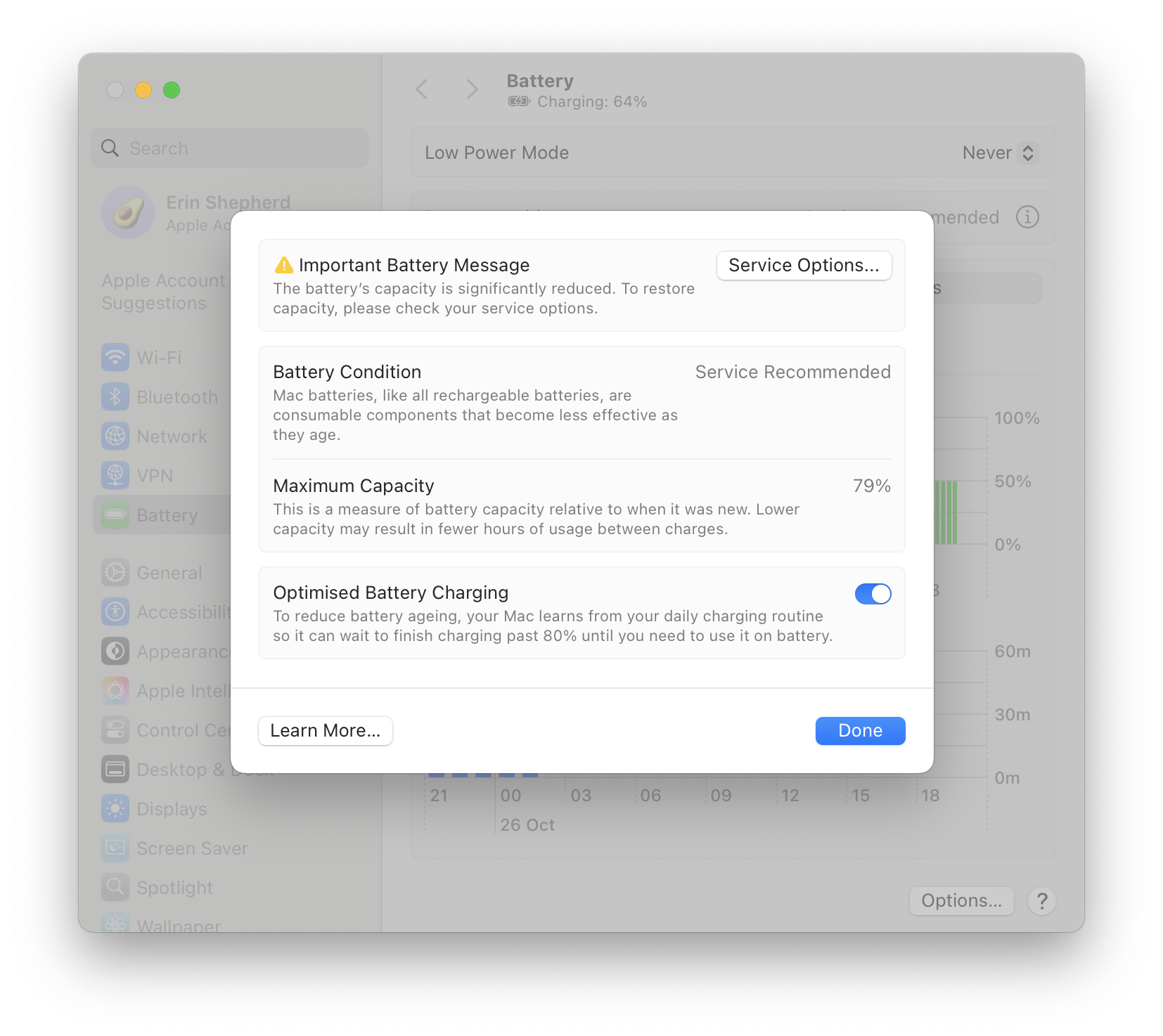

Womp. I guess it did reach the design life of 1000 cycles and it is 4.5 years old and heavily used, so not unexpected tbh.
Maybe I can get the screen replaced at the same time, I've got a couple of marks and lost a couple of backlight LEDs.
For anyone trying to interpret Anthropic's S1 - the "Change in fair value of convertible notes, etc" line with the $72B loss as of June 2026? That's "we have given out a lot of options and the value of our shares have increased and hence these options are now worth more". No "actual" money has been lost here.
It's not nothing (as a protective shareholder you should be very much worried about dilution!) but their actual cash and asset loss over the period is ~€8B
On the operating side they are/were actually very close to profitability, though whether that holds with their recent price cuts is another matter!
The poll so far between Twitter, Bluesky and Mastodon. I think it looks less absurd than last time, but still pretty clear that the base is divided. bsky.app/profile/mits...
Had a headache all morning and felt a bit grim. Eventually walked into the kitchen and saw the collection of caffeinated beverages on the shelf.
Only at this point did it click that "wait. Maybe it's caffeine withdrawal"
The original Tomb Raider's a great Halloween game! Everything Atlantean in it is fantastically unsettling, and their existence in a game that's "supposed" to be about Cool Gun Lady only makes it even more disturbing:
Me: why is one of my services taking 3 whole minutes to pick up its background jobs
...me a few minutes later, on the database server_
apk add chrony && rc-update add chronyd default && rc-service chronyd start
fucking timesync man.
Maybe Unix systems should ship an actual certificate validation daemon that speaks the Server-Based Certificate Validation Protocol (SCVP) or similar so that
- everyone can share one SCT-checker etc,
- we can centralise fetching updated revocation lists,
- we can centralise the logic we'll need for merkle tree certifikates,
- we don't have repeats of mistakes like those times certificates ended up in the CA Certificates bundle because they were in the Mozilla root store to be explicitly revoked
bonus points if for k8s & docker setups you can just bind-mount the socket into the container.
Perhaps if Chainguard are on your advance disclosure lists, they shouldn't be
On October 21st at 07:41 UTC, more than six hours before the coordinated release, Chainguard unilaterally broke the embargo and published built images containing the fix. Like other distributors, Chainguard had received the patch in advance so its users could update the moment the vulnerabilities were disclosed. Any attacker could now study the fix in binary form while every other PHP user was still waiting for the release. This disregarded weeks of work by many parties toward a coordinated disclosure.
I looked at some litter on the floor of the S-Bahn and it was the box from a V-Cube 4???
Berlin, you confuse me
We talk about the problems with technical solutions to social problems. Well, this is a social solution to a technical problem
Can't believe the definition of UNIX Time was so unfixably bad we as a society decided we had to abolish UTC instead
(The CGPM has voted to abolish the leap second)
Mandatory email OTP is one of the most infuriating creations of mankind
Please stop hashing the public key first (or: ML-DSA's µ annoys me)
A goal one might have when designing a signing algorithm is to prevent signing a message one has not seen.
Signing a message one hasn't seen might sound difficult at first, but most classical signature algorithms, as commonly used, sign a hash of the message, rather than the message itself. This kind of arrangement is necessitated by the fact that the underlying algorithms are only capable of signing messages of a limited size. You might not have seen the message, but you might have seen the hash of it, or another signature which encodes said hash. In many protocols, this lets you produce a valid signature on a message you've never seen. That's rarely a problem in practice, but it can be surprising, and it's a pitfall for the unsuspecting protocol designer.
More recent algorithms take steps to prevent this:
- Ed25519 signs
SHA-512(R || PubK || M)where R is functionally a random curve point, PubK is the public key, M is the message, and||is the concatenation operator - ML-DSA signs
SHAKE-256(SHAKE-256(PubK, 64) || 0x00 || len(ctx) || ctx || m, 64)(where ctx is a 0 to 255 byte context string)
This can complicate your signing code, particularly when dealing with HSMs or smart cards, but it doesn't require majorly reworking your signing process. Unfortunately, on the verification side things are less rosy.
The challenge
As a general rule of thumb, we should avoid touching the body of a signed message until we've verified the signature. Also as a general rule of thumb, cryptographic protocols where there are multiple signers put the signer's identity within said body (X.509, most JWT and CWT usages, SAML, I'm looking at all of you, but you're not the only ones).
This means the verification process ends up being
- Gingerly parse the message
- Dig through as much message as necessary to identify the signing key
- Actually verify the message
- Actually consume the message
Often (JWT, CWT and SAML again), there's either no key identifier present in the signed message, or it's permitted for multiple signing keys to share a key identifier†. This means that, if the issuer has multiple keys, you may have to do multiple trial-verifications to work out if the message is actually valid.
One nice property that all of these protocols have (except XML Digital Signatures, but nobody thinks XML Digital Signatures were a good idea) is that they carry the signing method in a header. So, with a traditional signing algorithm, you have the option of
- Parsing the header
- Identify algorithm and hence the hash algorithm
- Hash the message
- Gingerly parse the message
- Dig through as much message as necessary to identify the signing key
- Actually verify the message
- Actually consume the message
This comes with two advantages:
- After step 3, you can throw away the raw message, reducing memory usage
- In step 6, you pay for the cost of verifying a signature for every attempted key rather than also the cost of re-hashing the message. In most cases messages are small and this cost is also small, but every little helps.
Unfortunately, it has the slight flaw that it doesn't work with either Ed25519 or ML-DSA as defined.
For ML-DSA, it would have been quite easy to re-arrange matters. If we instead computed SHAKE-256(0x00 || len(ctx) || ctx || m || SHAKE-256(PubK, 64), 64) (i.e. we put the public key hash in at the end), then we can hold our SHAKE-256 context around and copy it for each trial verification. We'd end up keeping just over 200 bytes of SHAKE-256 context around (instead of 64 bytes of output), but that's not too bad. Unfortunately, that's not the choice that was made and we'll just have to deal with it.
Ed25519 is slightly more challenging. If we reversed the hash computation to be SHA-512(M || R || PubK) instead, it would be vulnerable to length extension attacks (for any SHA-512(X) you can extend it into SHA-512(X || some predictable garbage || Y) for any arbitrary Y).
Fixing that when Ed25519 was published in 2011 would be somewhat tricky, though the easiest option without truncating the hash is just to sign SHA-512(SHA-512("ed25519 domain separation" || M || R || PubK)).
Since we don't have a time machine, it's all a bit academic. In 2026 you can just avoid the problem by using SHA-3, BLAKE2, a truncated SHA-2 variant, or any other modern hash function which isn't vulnerable to length extension attacks.
In the meantime I'll just sigh and hope we can reduce the number of signatures we pass around, given they're really becoming rather large and expensive.
† You may be thinking it somewhat defeats the purpose of having a key identifier if they aren't unique. I don't disagree!
For extra pain this didn't show up as more than a handful of receive errors because most of the packets getting yeeted had such a bad SNR it didn't recognise them as packets
In the continuing tale of networking hauntedness, I've had some mysteriously slow downloads for months, that finally annoyed me enough to go properly debugging 😭
Turns out that fiber that looked plugged into the SFP wasn't and I had 1-5% packet loss on a primary link on our LAN
"Mistral said Le Chonk - officially named Mistral Large 4 - will be made fully public on October 27." How is this real text from a real Reuters article?! 😭https://www.reuters.com/world/china/mistral-ceo-says-new-ai-model-beats-chinese-ones-some-areas-2026-10-06/
I don't really like this prediction but I think it's coming.